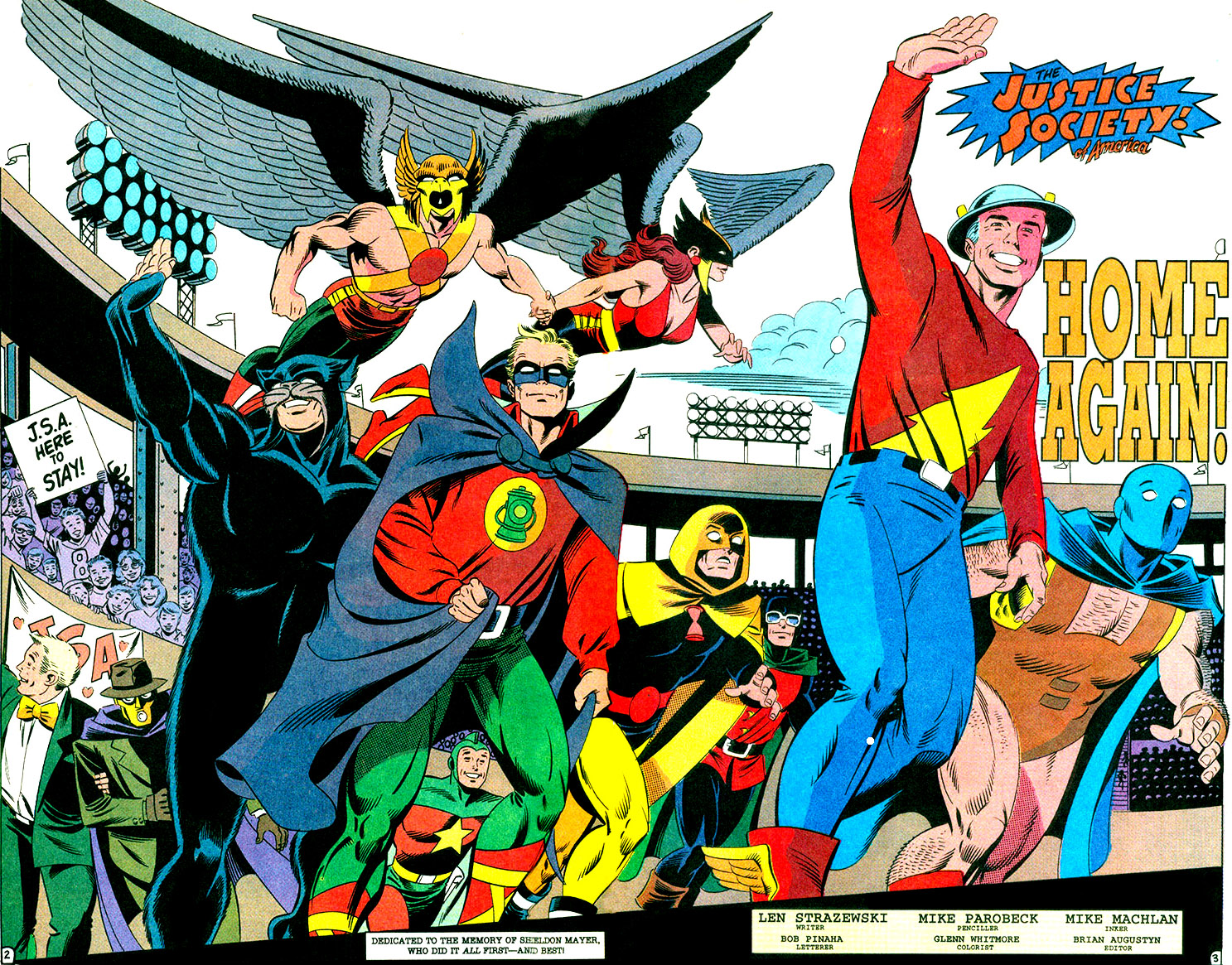
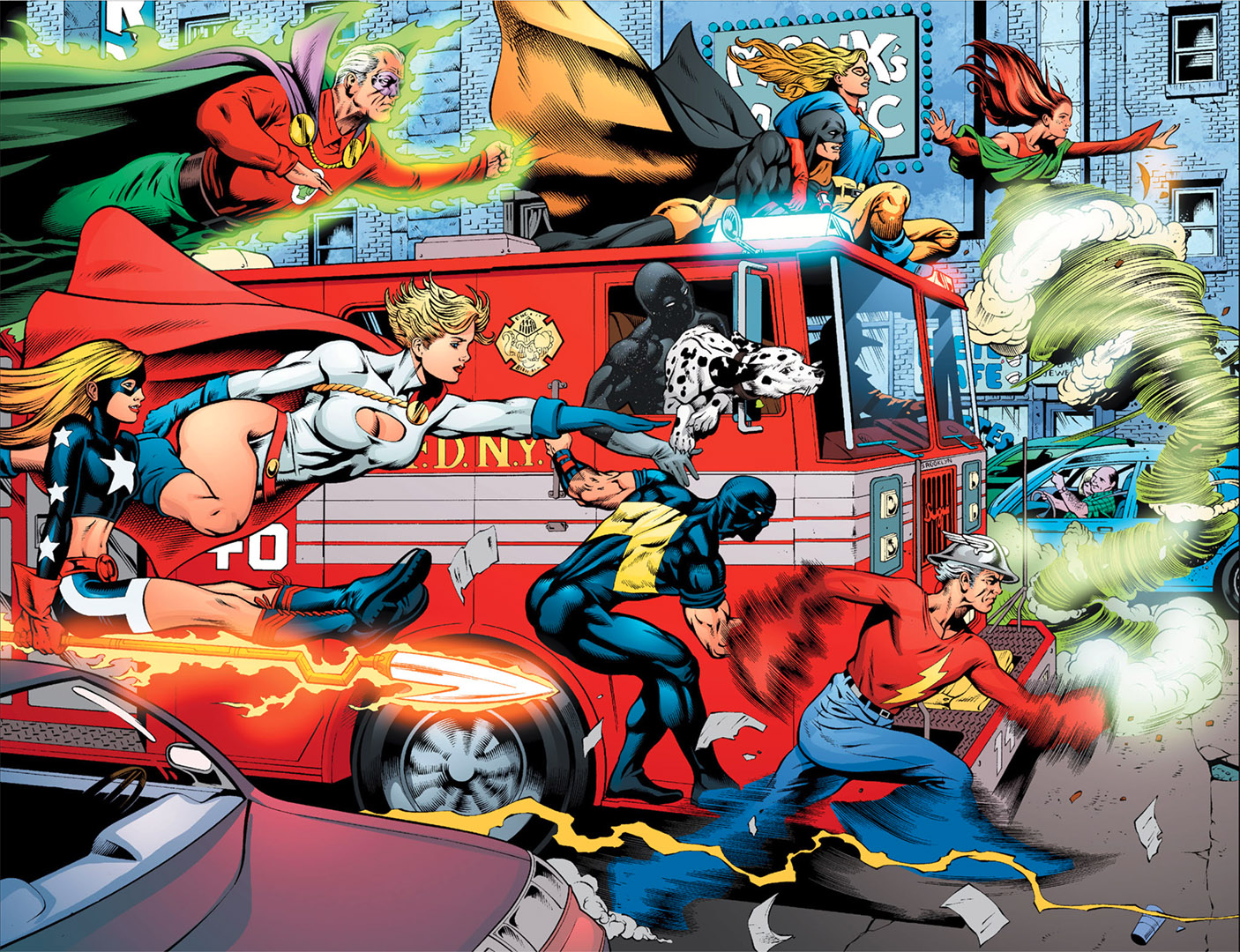
The JSA returns from Limbo — and into their own monthly series.
From Justice Society of America vol. 2 #1 (1992);
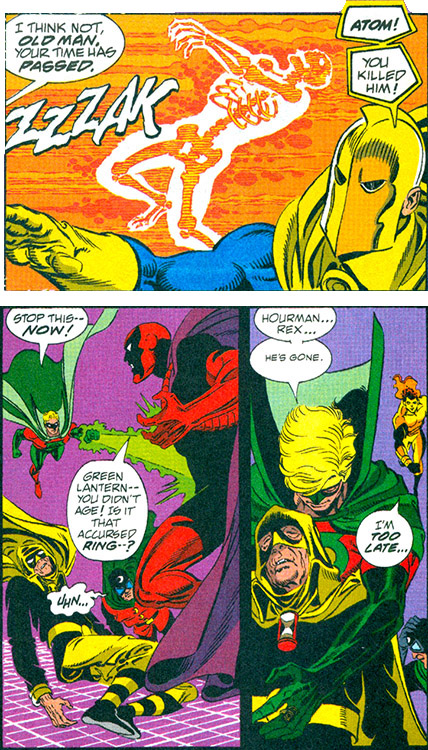
art by Mike Parobek and Mike Machlan.Extant kills the Atom, Hourman and Dr. Mid-Nite. From Zero Hour #3 (1994); art by Dan Jurgens and Jerry Ordway.
As with anything, if you put it away for a long enough time, people will grow nostalgic about it. This nostalgia leads to renewed interest.
After the JSA went into Limbo, their old headquarters in Gotham City was converted to a museum in their honor. Seven years later,
the JSA was freed from Limbo in a crossover event known as Armageddon Inferno. During
the time they were gone, Infinity, Inc. had been decimated and disbanded. Hawkman and Hawkgirl
had become grandparents, but their son, Hector, had died.
The JSA then starred in a new ongoing series (1992) which featured lively art and storytelling but did not succeed in sales. Many of the team's members returned to active adventuring and they set up a new headquarters in Gotham
City. They faced old enemies such as the Ultra-Humanite and Kulak.
Their former ally, Johnny Quick hung out with them for awhile, as did his daughter Jesse Quick. (Justice Society of America vol. 2 #1)
Johnny Thunder adopted a girl named Kiku, who was born of the native land from where his Thunderbolt originated. (#3, 7) (His first adopted daughter, Peachy Pet, invented frozen yogurt and during his stay in Limbo, she had amassed great wealth for the family). Jay and Joan Garrick began spending more time with the "Flash family," mentoring young speedsters including Wally West (Flash III), Jesse Quick, and Barry Allen's grandson, Impulse.
Writer Len Strazewski called the cancellation of JSA vol. 2 "a capricious decision made personally by Mike Carlin because
he didn't like Mike's artwork or my writing and believed that senior
citizen super-heroes was not what DC should be publishing. He made his
opinion clear to me several times after the cancellation."
Many JSA members enjoyed vital new roles — until editors again branded them obsolete. During the course of 1994's, Zero Hour event, Atom, Hourman and Dr. Mid-Nite
were slain; Wildcat suffered a heart attack; and the rest of the team was
aged well past their prime. (Zero Hour #3–2) The JSA disbanded once again and only three remained active. Alan Scott was rejuvenated by his ring and took the name Sentinel.(Showcase '95 #1) Starman retired to his observatory and passed
his cosmic 'torch' onto his sons David and Jack. (Starman #0)
In 1999, the Flash, Green Lantern, Hippolyta, and Wildcat (who revealed that he acquired "nine lives" back in the 1940s) reteamed with the new Justice League in a case involving Johnny Thunder's mystic
Thunderbolt. At the conclusion, the young Jakeem Thundergained control of the genie and the stage was set for the formation a new JSA. (JLA #28-31)
A Note About Hypertime (est. 1999)
For a time, any anomalies in the timeline were explained as part of
"Hypertime." Created by Mark Waid during the 1999 Kingdom event, Hypertime
was an obvious attempt to explain rampant poor continuity.
It was described like an infinite branching of the DCU timestream: "tributary" timelines were said to diverge from the "main" timeline and then sometimes those tributaries fed back into the main timeline.
For example, following the Crisis, Power Girl was explicitly removed from any membership in the JSA. Here the timeline diverged and an "Elseworlds" tributary traveled on in which she was a JSA member; the main timeline continued without her as a member. Gradually, more and more stories were told placing her firmly back into JSA membership (cemented in JSA: Our Worlds at War).
It was because that erstwhile tributary was "feeding back" into
the main timeline.
Series from this period:
Dr. Fate vol. 2 #1–41 (1988–92) Eric and Linda Strauss become Dr. Fate, then succeeded by Kent and Inza Nelson.
Armageddon Inferno #1–4 (1992): The return of the JSA
from Limbo to current DC continuity. Yet again, overwhelming fan response
led to...
Justice Society of America vol. 2 #1–10 (1992-93): The JSA
reestablishes itself as an active superhero team. Jessie
Quick debuts.
Sandman Mystery Theatre #1–70 (1993–99)
The Spectre vol. 2 #1–62 (1993–98) Jim Corrigan struggles for his own redemption, and the vengeful nature of his alter ego.
Starman vol. 2 #0–80 (1994–2001) When David Knight is killed in battle, his younger brother, Jack Knight, becomes Starman VII.
Zero Hour: Crisis In Time #0-4 (1994): The JSA is decimated; Hourman, Dr. Mid-Nite, and Atom
are killed, Wildcat has a heart attack, Hawkman and Hawkwoman are merged into
one being.
Damage #0–12 (1994–95) Grant Emerson (the son of the Atom I) becomes the superhero Damage.
Kingdom Come #1–4 (1996)
Batman and Wildcat #1–3 (1997) Wildcat in a fist fight
with Batman! And holding his own!
Catwoman and Wildcat #1–4 (1998): Another Wildcat
adventure, due to the popularity of Batman And Wildcat.
Green Lantern & Sentinel #1–3 (1998): The Golden
Age and current Green Lanterns team up with Jade and
Obsidian.
All Star Comics #1–2, Adventure, All-American, National, Sensation,
Smash, Star-Spangled, and Thrilling Comics #1 (1999): A nine-part
story set in the 1940s, meant to reintroduce people to the Golden Age
JSA before their return as a modern team.
Featured appearances from this period:
Starman vol. 1 #26-27 (1990) David Knight takes over his father's role as Starman.
Green Lantern vol. 3 #19 (1991) Alan Scott guest stars. • #71 (1996): Alan Scott restores his wife's soul, but in the process Molly is returned to her real age. • #109 (1999) Sentinel, Obsidian and Jade celebrate Christmas.
Green Lantern Corps Quarterly #3 (1992) The JSA discovers that Black Canary I passed away. • Green Lantern Corps Quarterly #5 (1993) Alan Scott's ring makes him younger.
Darkstars #6–7 (1993): The Golden Age Hawkman
and Hawkgirl guest star.
Eclipso #13 (1993) Dr. Midnight, Wildcat II, and Commander Steel are all slain by Eclipso.
The Flash vol. 2 #76 (1993) The Flash and Johnny Quick track down Max Mercury. • Flash vol. 2 #97–100 (1995) Terminal Velocity: The Flash Family vs. Kobra. • Flash vol. 2 #108-109 (1995) Dead Heat: The Flash Family vs. Savitar.
Justice League America #78-79 (1993) Jay Garrick replaces Superman as temporary field leader of JLA.
Justice League Europe #47-50 (1993) The JSA aids the JLE against Sonar.
Hawkman vol. 3 # 13 (1994) Carter and Shiera Hall are merged with Katar Hol (Hawkman III).
Justice League Task Force #10-12 (1994) Hourman and the Black Canary briefly join the JLTF.
Showcase '94 #8 (1994) Wildcat reconciles with the Montez family, who blame him for the death of Yolanda Montez (Wildcat II).
Showcase '95 #1 (1995) Alan Scott discovers that after the destruction of his ring he has internalized the power of the Starheart. He adopts the name Sentinel.
JLA #28-31 (1999): A reformed JSA teams up with
the JLA to stop an imp from the 5th dimension.
The Kingdom #1–2 (1999) The original Superman of Earth-2 (trapped in Alexander Luthor's "heaven") contemplates his "captivity" and searches for a way out.
JSA for the New Millennium (1999–2005)
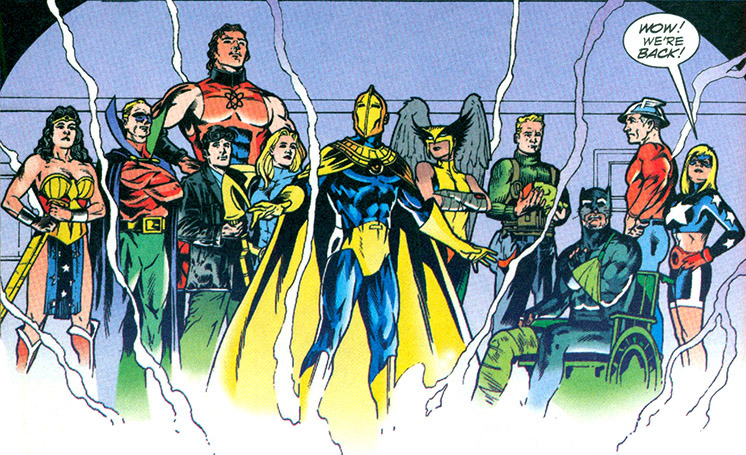
The new JSA, after shepherding the new Dr. Fate into existence. Hippolyta, Sentinel, Atom-Smasher, Starman, Black Canary, Dr. Fate, Hawkgirl, Sand (holding Hourman's head), Wildcat, Flash, and Star-Spangled Kid
II.
From JSA #4 (1999); art by Stephen Sadowski and Michael Bair.
Several months after the team-up with the new JLA, Wesley Dodds, the original Sandman sacrificed his life
in Tibet. (JSA Secret Files #1) At his funeral,
the remaining JSA members and several of their
associates (Star-Spangled Kid II, Hourman III, Starman VII, Atom-Smasher, Black Canary II, and Sandy the Golden Boy), were attacked by a group of
undead monsters known as the Sons of Anubis, who were seeking the
relics belonging to the late Dr. Fate. (JSA #1) This led the heroes on a quest to find
the infant who was destined to become the new Dr. Fate.
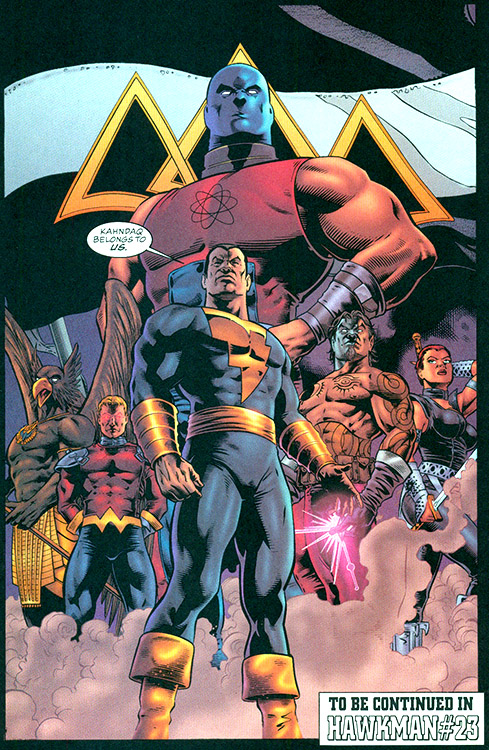
Black Adam leads a group including former Infinity Inc.
members to take over his home country of Kahndaq.
From JSA #56 (2004); art by Don Kramer and Keith Champagne.
This group was joined by a new Hawkgirl (Kendra Saunders, granddaughter of Speed Saunders,
and grandniece of Hawkman and Hawkgirl) just as the team
managed to locate the Fate-child. (#2) That
child was magically accelerated to maturity and indeed became the new Dr. Fate. (#3) What's more, he was the reincarnated Hector Hall (Silver
Scarab). The heroes decided to reform the JSA and use Wesley
Dodds' New York mansion as their new base of operations.
The theme of "legacy" permeated the JSA series. Sandy
the Golden Boy changed his codename to Sand and became the team's first chairman. Sandy also possessed extended longevity as a result of his metaphysical transformation. Also joining the team was the new Mr. Terrific (Michael Holt) (#5) and Dr. Mid-Nite II(Pieter Cross), who became the DCU's go-to metaphysician. (#7-9)Jakeem Thunder became a reserve member. (JSA Sec. Files #2)
Their most deadly rivals during this time were the new Injustice Society. It was formed by Johnny Sorrow with Black Adam, Shiv, Rival and the Thinker. (#16-21) Black Adam took to the straight-and-narrow after this and inserted himself into the JSA's affairs. Eventually his arch enemy, Captain Marvel, joined the team as well. (#19–37) Black Adam assisted the team in a mission to the alien planet Thanagar, which restored the original Hawkman to life. (#23-25) Mr. Terrific was elected the JSA's next long-running chairperson. (#27)
Another new foe was Roulette, was the granddaughter of the original Mr. Terrific. (JSA Secret Files #2, JSA #27-30) And when Black Canary resigned, she designated Power Girl as her replacement. (#31)
Black Adam's turnabout didn't last for long. He descended into tyranny once more when the JSA refused to take action against the villain Kobra. Atom-Smasher (formerly Nuklon) left with Adam and they were joined by other former Infinitors Northwind, Brainwave Jr., plus Eclipso II. Hawkman ultimately brokered a deal with Black Adam to remain inside the bounds of his home country, Kahndaq. For this, Hawkman was expelled from the JSA. (#45, 51, 56-58)
Series from this period:
Hourman #1–25 (1999–2001) Following the android Hourman from the future.
Dr. Mid-Nite #1–3 (1999) Introducing Pieter Cross.
JSA #1–72 (1999–2005) The next generation of heroes officially assumes the mantle of the JSA.
Stars & S.T.R.I.P.E. #0–14 (1999–2000) Starring the new Star-Spangled Kid and the former Stripesy.
DC Two Thousand #1-2 (2000)
JSA All-Stars #1–8 (2003–04) Focusing on members, and versus the Injustice Society.
Featured appearances from this period:
Martian Manhunter vol. 3 #18–19 (2000) At Black Canary's request, the Martian Manhunter leads a training session with the junior JSA members.
Sins of Youth: JSA (2000) Adult heroes are transformed into kids, now led by Starwoman.
Impulse #67 (2000) Flash, Wildcat, and Star-Spangled Kid welcome back Max Mercury.
Golden Age Secret Files #1 (2001) Clark Kent writes about the Crimson Avenger.
JSA: Our Worlds at War (2001) Sand recruits an army of All-Stars.
JLA/JSA: Virtue & Vice (2002) Team-up against Despero and Johnny Sorrow.
Hawkman vol. 4 #19, 23–25 (2003–04) Hawkman abides by Black Adam's new nation and meets the new Northwind.
JLA/JSA Secret Files #1 (2003)
Building a Society... a Kingdom? (2006–2011)
Left: The all-new JSA. From Justice Society of America #9 (2009); art by Dale Eaglesham and Ruy José.
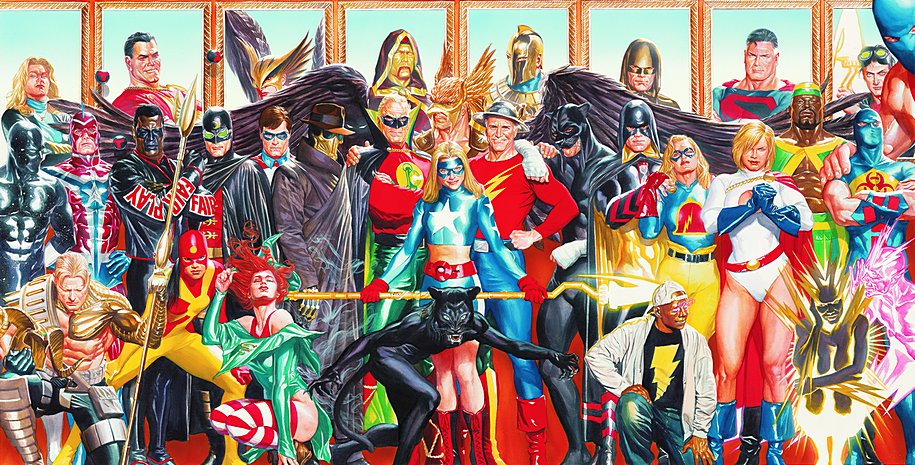
Right: A pinup from an anniversary issue showing the same scene from a different angle! From The Flash #750 (Sept. 2020); by Dale Eaglesham.This painting by Alex Ross was used on the cover of Geoff Johns' last issue, Justice Society of America #26 (2009).
Infinite Crisis
DC's next universe-shaping event, the Infinite Crisis (2005), restored some of the glory of its Golden Age characters. This crisis was used bring back the DC multiverse. It began when Superboy Prime pummeled the crystalline
barrier between realities. He'd been living in this ever since the first Crisis. It was created by Alexander Luthor (of Earth-3), and was also home to the original Superman and Lois Lane!
Once free, Superboy and Alex Luthor went mad and created a new multiverse consisting of precisely 52 parallel universes. Power Girl was reunited with her cousin Superman (Infinite Crisis #2), who died in the end. (#7)
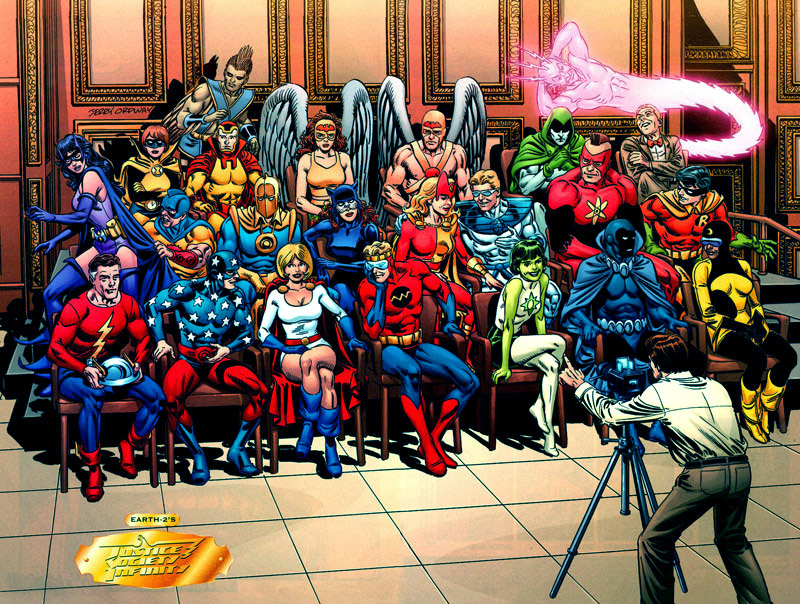
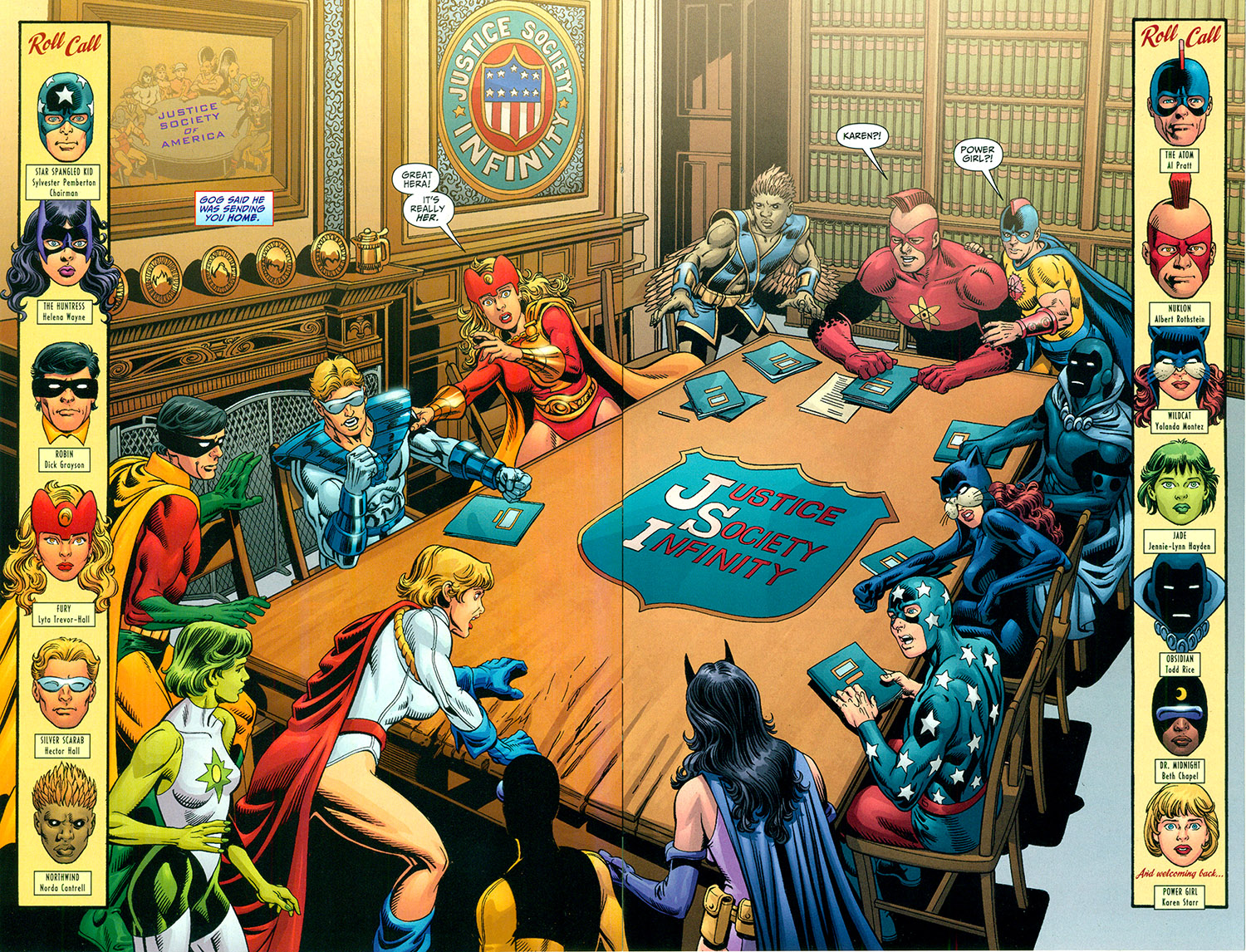
What might have been... the Justice Society Infinity pinup from JSA Kingdom Come Special: The Kingdom #1 (2009). Art by Jerry Ordway.Justice Society Infinty. From Justice Society of America Annual #1 (2008); art by Jerry Ordway and Bob Wiacek.
Earth-2 in this new multiverse was very similar to the pre-Crisis Earth-Two. The continuity of this Earth picked up from the original Earth-Two — as if the Crisis had not happened and things went on normally. (JSofA vol. 3 #11) The JSA and Infinity, Inc. had merged into Justice Society Infinity. In time, Power Girl found her way there, where she had hoped to discover her cousin alive again (he died in Infinite Crisis #7). She was crushed to find another Power Girl—a native of that universe—already existed! (JSofA Annual #1, JSofA #18-20)
Many JSA new members during this time were inspired by
characters in Kingdom Come. Art by Alex Ross.The new kids. From JSA All-Stars #2 (2010); art by Freddie Williams II.
Justice Society of America vol. 3
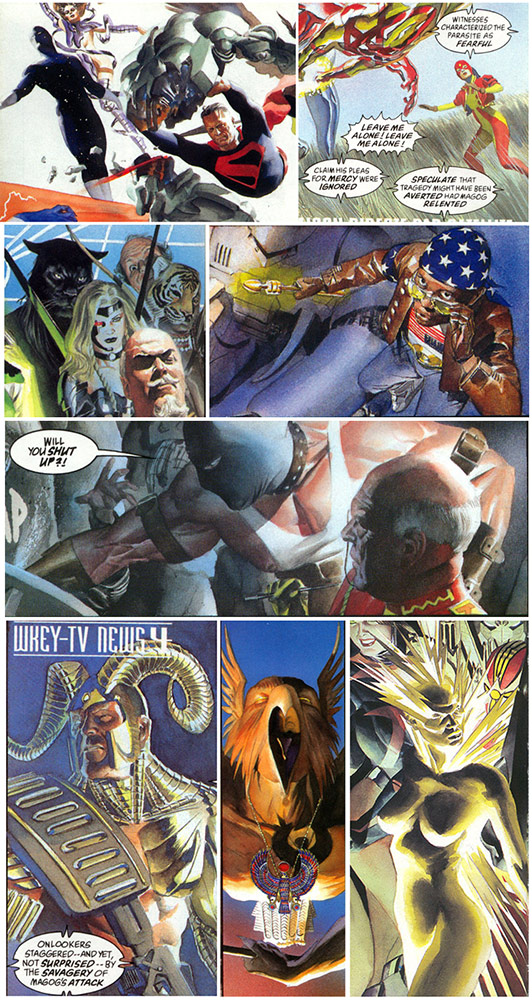
JSA had been a hit; it was relaunched as Justice Society of America (volume 3) and Geoff Johns settled in for a long-running story that linked the Justice Society to the mythology created for 1996's Kingdom Come. Kingdom Come introduced scores of new "legacy heroes" — those who took up the mantles of past heroes.
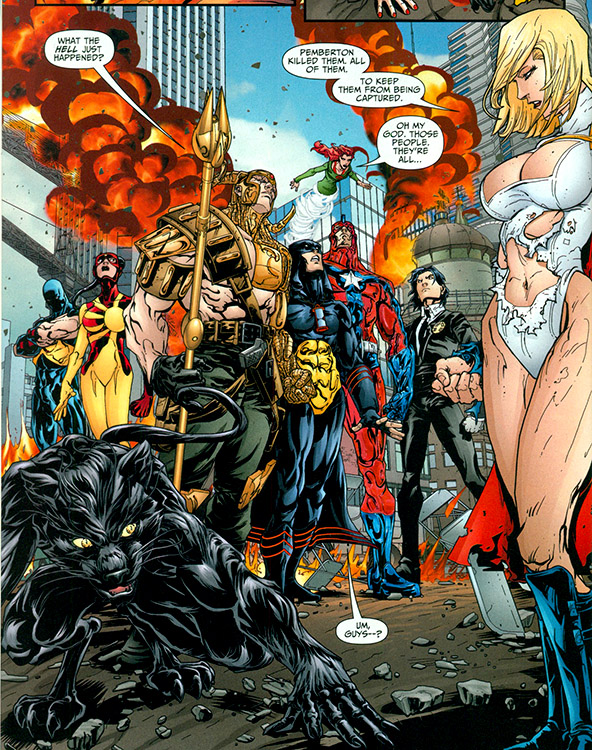
In "Thy Kingdom Come," many of these heroes were formally introduced into mainstream DC universe as members of the JSA. They included Liberty Belle II (Jesse Quick) and Obsidian (JSofA vol. 3 #1); Cyclone (granddaughter of the original Red Tornado); Damage (son of the Atom); Starman VIII(Star Boy of the Legion of Super-Heroes) (JSofA vol. 3 #1);Tomcat (long-lost son of Wildcat) (#4); and Citizen Steel. (#7)
Kingdom Come took place on Earth-22 and that universe's Superman also found himself stranded on Earth-0, where he joined the JSA. A dozen issues into this series, several more K.C. heroes joined: Judomaster III, Jakeem Thunder, Lightning, Amazing Man III, Mr. America III, and Lance Corporal David Reid. (#11-12)
Their adversary was an alien god called Gog, who transformed David Reid into a servant called Magog. (#18)
The success of this storyline led to more ongoing JSA titles. In 2005, there was JSA: Classified, which focused on individual members. JSA vs. Kobra was a crossover with Checkmate, which starred Mr. Terrific. The team became so large (planned that way?) that it was split into two teams in 2010; after Justice Society of America #40, JSA All-Stars featured Power Girl at the helm, leading many of the younger heroes on more proactive missions.
The main JSA title ended with the death of Alan Scott and with Wildcat apparently exhausting the eighth of his nine lives. After these series ended, the DC Universe was rebooted.
Series from this period:
Infinite Crisis #1–7 (2005) Bringing back the Golden Age Superman and restoring DC's multiverse.
JSA #73–85 (2005–06) Leading into Infinite Crisis.
JSA: Classified #1–39 (2005–2008) Focusing on individual members.
Checkmate vol. 2 #1–31 (2006–2008) Alan Scott and Mr. Terrific play integral parts in the new global peacekeeping initiative.
Hawkgirl #50–66 (2006–07) After Infinite Crisis, Kendra takes center stage.
Countdown to Mystery #1-8 (2007) Dr. Kent V. Nelson becomes the new Dr. Fate.
Justice Society of America vol. 3, 57 issues (2007–11) The JSA grows by leaps and bounds.
JSA vs. Kobra #1–6 (2009–10) Crossover with Checkmate.
Magog #1–12 (2009–10)
Power Girl #1–27 (2009–11)
JSA All-Stars #1–18 (2010–11) Power Girl leads an offshoot of the now oversized JSA.
Featured appearances from this period:
JSA Kingdom Come Special: Magog (2009) David Reid goes to Iraq.
JSA Kingdom Come Specials (2009) …
Magog: Gog's followers go with him across Africa on the way to Kahndaq.
Superman: Superman-22 tells his story
The Kingdom: Gog's influence grows.
Blackest Night #1 (2010) Hawkman and Hawkgirl are killed. #4: Damage is killed. #8: Carter & Shiera Hall, and Jade are brought back to life.
Blackest Night: JSA #1–3 (2010) Dead JSA members rise and Mr. Terrific invents a one-time bomb to destroy Black Lanterns.
Justice League of America vol. 2 #44–48 (2010) Crossover involving the powers of darkness, and the Starheart.
Justice League: Generation Lost #13 (2011) Magog is killed by Maxwell Lord.
New 52: New Earth-2 (2011–2019)
DC rebooted its entire multiverse with an initiative called "The New 52." In addressing JSA-related characters, they chose to eschew "legacy" and go for a total update. Classic Justice Society members were reimagined by James Robinson for a contemporary version of Earth-2.
This new, youthful version never went by the name "Justice Society" and it's heroes were called "wonders." The Earth 2 series was set on a parallel world with its own Superman, Wonder Woman and Batman. These wonders lost their lives in battle with Steppenwolf of Apokolips. Supergirl and Robin survived it and found refuge on Earth-0, where they adopted the identities of Power Girl and the Huntress.
Five years later, they found a way to return to Earth-2, where new heroes with somewhat supernatural powers had emerged: Jay Garrick, Alan Scott, the Atom, Terry Sloane and many more.
This was a richly developed world but it was totally dismantled in service of a convoluted crossover event, "Future's End." The potential for the new Earth-2 was misspent and its fate is unresolved.
Mister Terrific (2011–12) This character was introduced on Earth-1, and he soon found discovered Earth-2 and became stranded there.
Earth 2 (2012–) Reintroducing the Golden Age characters in fresh new ways.
World's Finest (2012–) Power Girl and Huntress adjust to Earth-Prime.
Earth 2: Future's End (2014) A weekly series crossing over with DC's Future's End
Featured appearances from this period:
Batman/Superman #1-4 (2013): The Earth-0 world's finest cross over.
Batman/Superman #8–9 (2014): Huntress and Power Girl team up with the Superman and Batman of Earth-0.
Supergirl #18–20 (2013): Power Girl guest stars.
Rebirth (2016–)
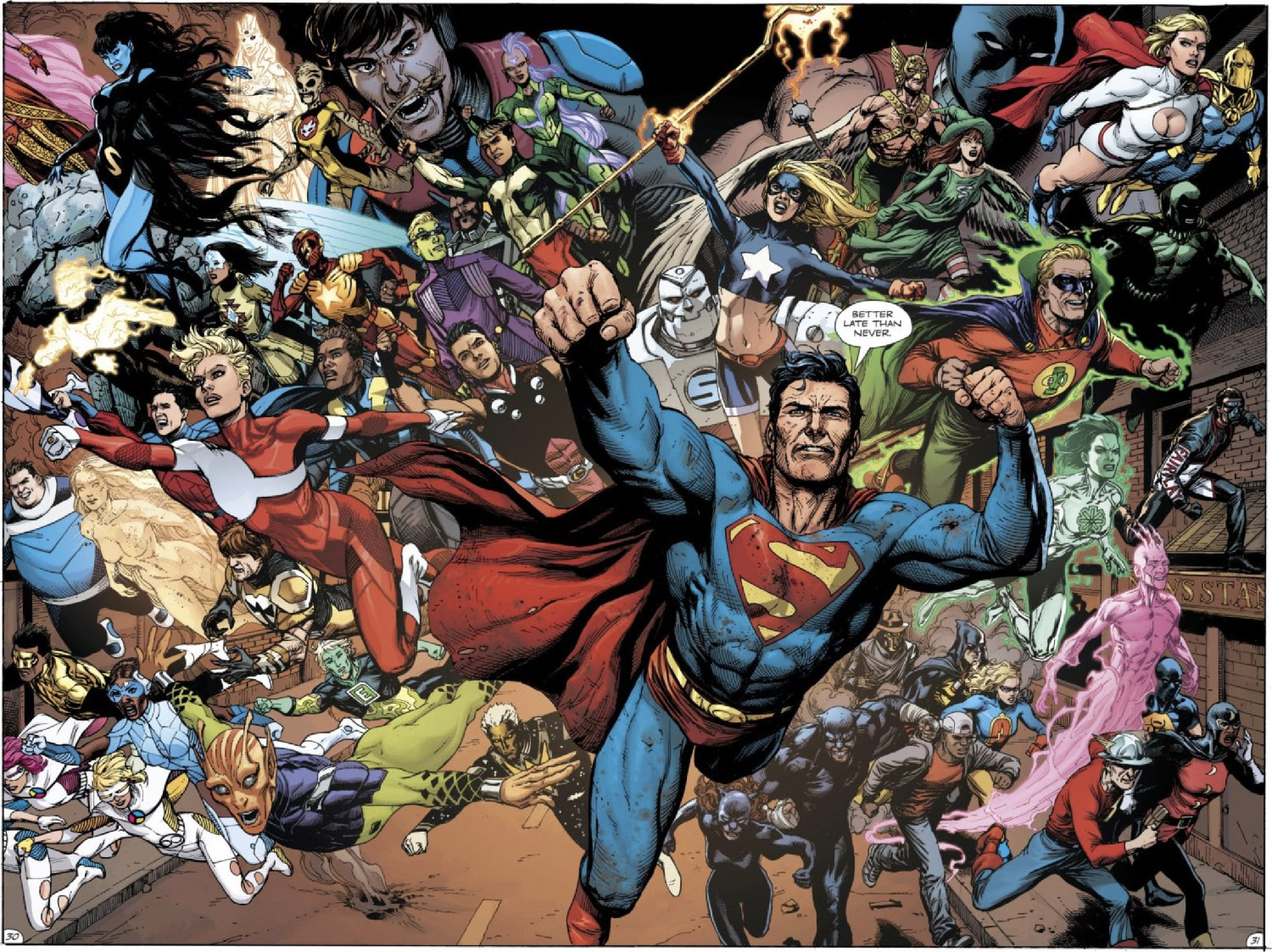
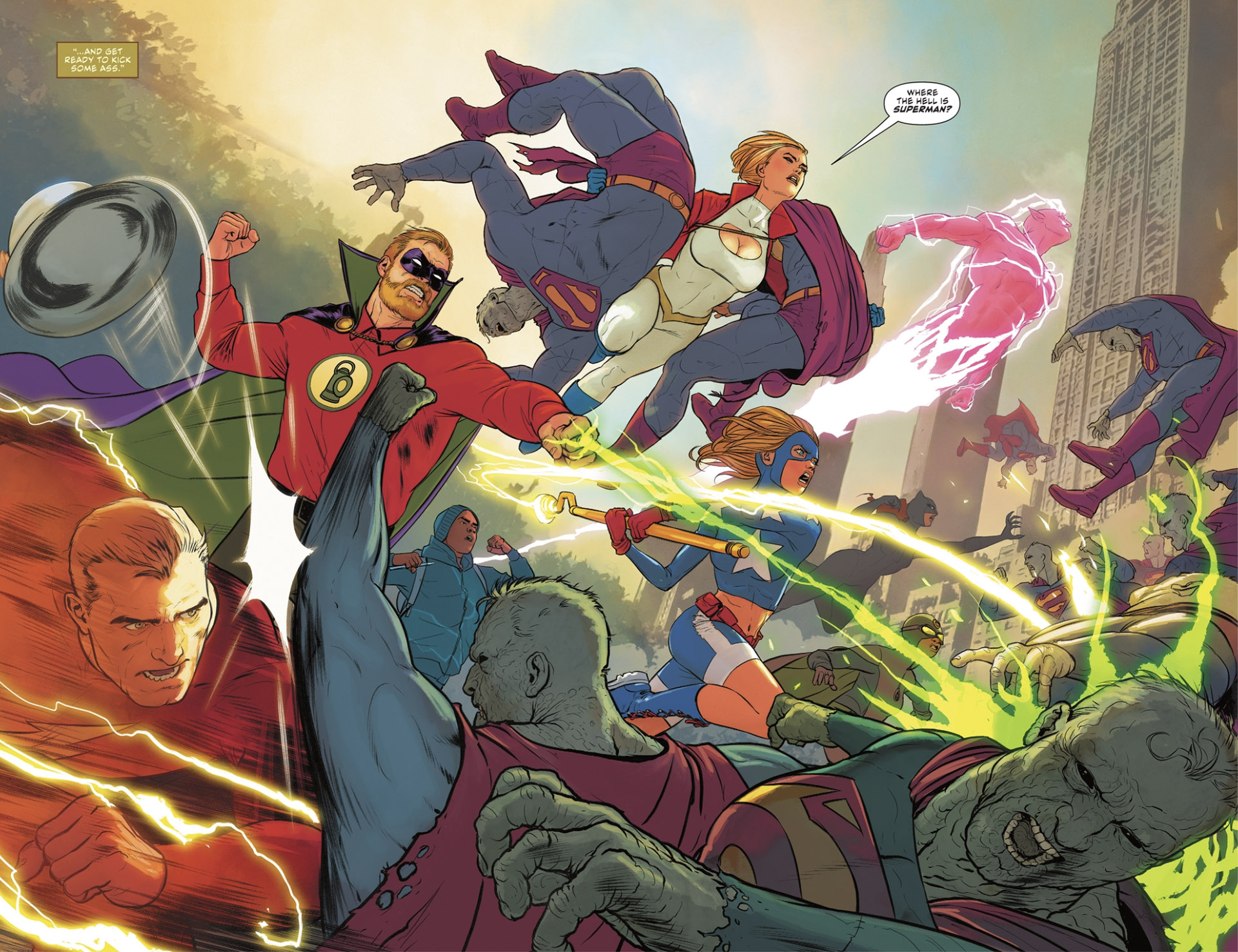
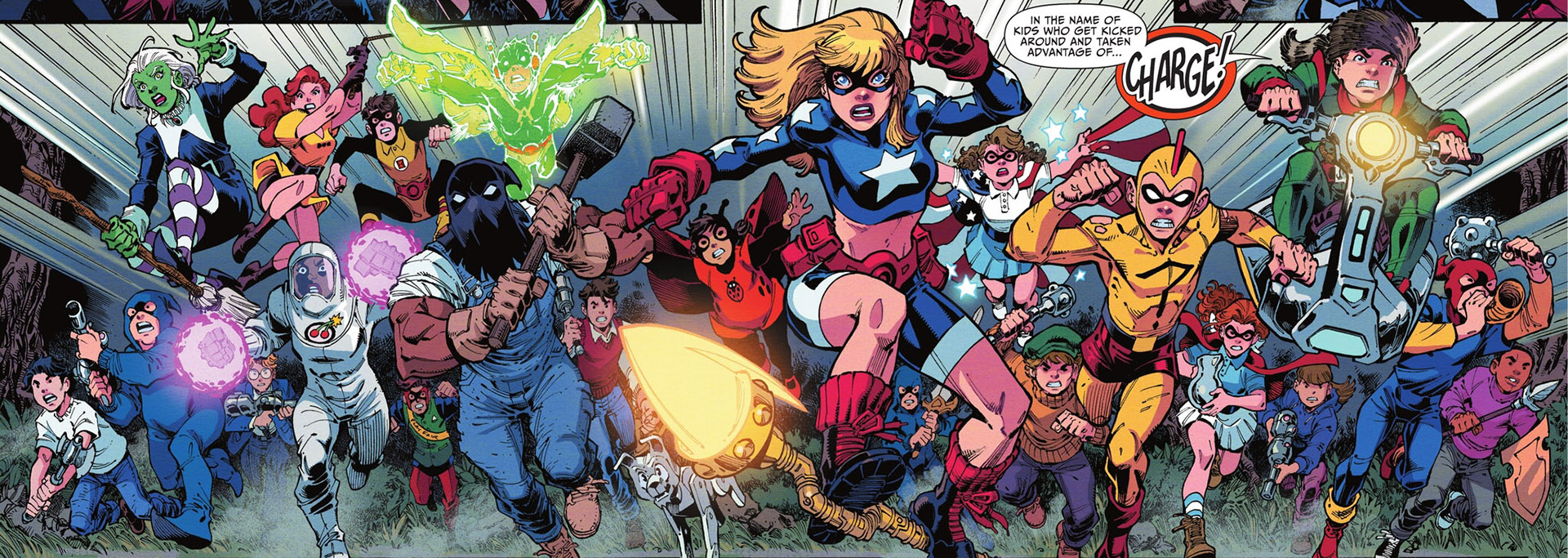
The Justice Society leaps back into the DC Universe. From Doomsday Clock #12 (Feb. 2020); by Geoff Johns and Gary Frank.The new Justice Society. From Justice Society of America vol. 4 #3 (May 2023). By Geoff Johns and Mikel Janín.Stargirl leads the rebellion of the lost children of the Golden Age. From Stargirl: The Lost Children #3 (Mar. 2023); by Geoff Johns and Todd Nauck.
Despite the Justice Society's popularity, JSA characters were largely omitted from the New 52, where "legacy" was a dirty word. In 2016, DC began "Rebirth," a mechanism for restoring its universe to its former glory. (Also, continuity in the New 52 universe was an unforgivable mess.)
It took several years for the Justice Society to return, though. Once again, Geoff Johns was its engineer. With Gary Frank, he produced DC Universe: Rebirth (July 2016), which led directly into the Doomsday Clock limited series. (In DC K.O. #1 [Dec. 2025], Mark Waid described the New 52 timeline thus, "Eventually, this timeline was reabsorbed, but for a brief period, it existed outside larger reality.”)
It was explained that Doctor Manhattan, a godlike being from another universe, was responsible for the New 52 reality. By preventing Alan Scott from becoming the Green Lantern, there was no Justice Society or legacy of heroes to inspire the Justice League. Manhattan witnessed how the Earth-0 reacted against this change; without a symbol of hope, Superman's life was without inspiration and a 'cancer' developed across the larger Metaverse.
Dr. Manhattan eventually saw his error and restored Alan Scott's origin as Green Lantern. The cascade effect was the restoration of the Justice Society (and the Legion) and the realignment of the entire Metaverse around an inspired, hopeful Superman. This new reality was a "Rebirth."
In 2019, the Justice Society was formally reintroduced, in "Justice League: Doom War." Their next ongoing series was teed up by the Infinite Frontier event(2021).
Geoff Johns and Mikel Janin surprised fans with some new, retcon characters in The New Golden Age (2023) and Stargirl: The Lost Children. These were the companion to a 12-issue limited series, Justice Society of America vol. 4 (2023), which introduced a new Helena Wayne Huntress.
In 2025, the new JSA series (vol. 2) by Jeff Lemire focused on the bringing the former members of Infinity, Inc. (Jade, Obsidian, Wildcat, Dr. Mid-Nite) to the front as the core of the Justice Society.
Series from this period:
Doctor Fate vol. 4, 18 issues (2016)
Doomsday Clock, 12-issue limited series (2017–2019)
Hawkman vol. 5, 29 issues (2018–2000)
Infinite Frontier, 6-issue limited series (2021)
Stargirl: The Lost Children, 6-issue limited series (2023)
Justice Society of America vol. 4, 12-issue limited series (2023)
Alan Scott: The Green Lantern, 6-issue limited series (2023)
Jay Garrick: The Flash, 6-issue limited series (2023)
Wes Dodds: The Sandman, 6-issue limited series (2023)